.

The first
Blood Moon eclipse in a series of four is
coming up
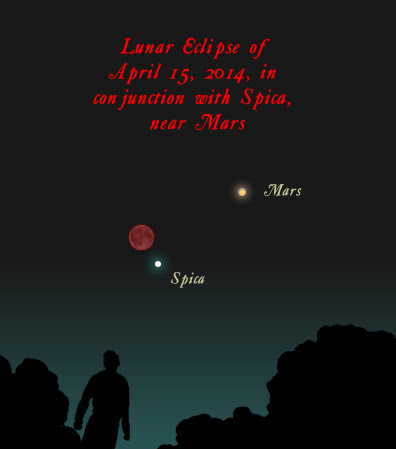
on the night of April 14-15, 2014. This total eclipse of the moon will
be visible from the Americas. We in astronomy had not heard the term
Blood Moon used in quite this way before this year, but now the term is
becoming widespread in the media. The origin of the term is religious,
at least according to Christian pastor John Hagee, who wrote a 2013 book
about Blood Moons.
Meanwhile, both astronomers and some proponents of Christian prophesy are talking about the upcoming lunar
tetrad – the series of four total lunar eclipses – beginning
on the night of April 14-15.
We at EarthSky don’t have any special knowledge about the Blood Moons
of Biblical prophesy. But, since they’re moons, and since people are
asking us, we wanted to provide some info. Follow the links below to
learn more about Blood Moons.
What is a lunar tetrad?
Blood Moons in Biblical prophecy
Dates of Biblical prophecy Blood Moons in 2014 and 2015
How common is a tetrad of total lunar eclipses?
Why is the term Blood Moon being used to mean a full moon of a lunar tetrad?
Other times in astronomy you hear “moon” and “blood” in same sentence.
Dates of Harvest and Hunter’s Moons in 2014 and 2015
Total lunar eclipse for the Americas on night of April 14-15
Not too late. EarthSky’s moon calendar as a fun way to enjoy the moon phases throughout the year.
A planisphere is virtually indispensable for beginning stargazers. Order your EarthSky planisphere
today.
 What is a lunar tetrad?
Both astronomers and followers of certain Christian pastors are talking about the
lunar tetrad
of 2014-2015. What is a tetrad? It’s four successive total lunar
eclipses, with no partial lunar eclipses in between, each of which is
separated from the other by six lunar months (six full moons)
Blood Moons in Biblical prophecy.
We’re not experts on prophecy of any kind. But we’ll tell you what we
know about the new definition for Blood Moon that has raised so many
questions recently.
From what we’ve been able to gather, two Christian pastors, Mark Blitz and John Hagee, use the term
Blood Moon to apply to the full moons of the upcoming
tetrad
– four successive total lunar eclipses, with no partial lunar eclipses
in between, each of which is separated from the other by six lunar
months (six full moons) – in 2014 and 2015. John Hagee appears to have
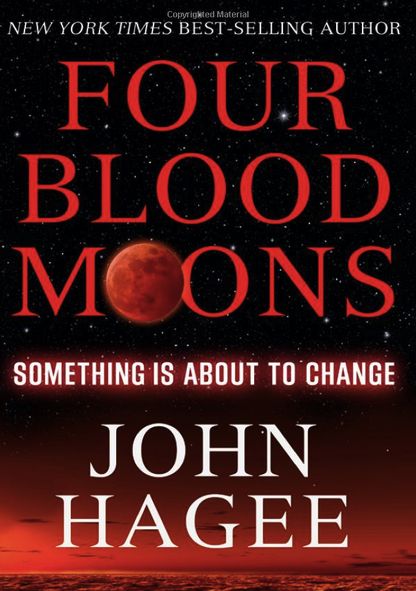
popularized the term in his 2013 book
Four Blood Moons: Something is About to Change.
Mark Blitz and John Hagee speak of a lunar tetrad as representing a
fulfillment of Biblical prophecy. After all, the moon is supposed to
turn blood red before the
end times, isn’t it? As described in Joel 2:31 (Common English Bible):
The sun will be turned to darkness, and the moon to blood before the great and dreadful day of the LORD comes.
That description, by the way, describes both a total solar eclipse
and total lunar eclipse. Sun turned to darkness = moon directly between
the Earth and sun in a total solar eclipse. Moon turned to blood = Earth
directly between the sun and moon, Earth’s shadow falling on the moon
in a total lunar eclipse.
 Dates of Biblical prophecy Blood Moons in 2014 and 2015.
 These are the dates for the upcoming
tetrad – four successive total lunar eclipses – in these years.
2014:
Total lunar eclipse: April 14-15
Total lunar eclipse: October 8
2015:
Total lunar eclipse: April 4
Total lunar eclipse: September 28
There are a total of
8 tetrads in the 21st century (2001 to 2100).
But proponents of this Biblical prophecy regard the upcoming tetrad as
especially significant because it coincides with two important Jewish
holidays: Passover and Tabernacles.
The April 2014 and April 2015 total lunar eclipses align with the
feast of Passover. The October 2014 and September 2015 total lunar
eclipses align with the feast of Tabernacles.
The Jewish calendar is a lunar calendar. In any year, it’s inevitable
that a full moon should fall on or near the feasts of Passover (15
Nissan) and Tabernacles (15 Tishri). Nissan and Tishri are the first and
seventh months of the Jewish calendar, respectively.
It is somewhat ironic that three of these four lunar eclipses are not
visible – even in part – from Israel. The only eclipse that can be seen
at all from Israel is the tail end of the September 28, 2015 eclipse,
which may be observable for a short while before sunrise.
How common is a tetrad of total lunar eclipses?
Depending upon the century in which you live, a
lunar tetrad
(four consecutive total lunar eclipses, spaced at six lunar months
apart from one another) may happen fairly frequently – or not at all.
For instance, in our 21st century (2001-2100), there are a total 8
tetrads, but in the 17th, 18th and 19th centuries, there were none at
all. If we include all the centuries from the 1st century (AD 1-100)
through the 21st century (2001-2100), inclusive, there are a total of
62 tetrads. The last one occurred in 2003-2004, and the next one after the 2014-2015 tetrad will happen in 2032-2033.
However, if we want to know which tetrads specifically fell on the
Jewish feasts of Passover and Tabernacles, there appear to be a total of
8 in these 21 centuries:
1. 162-163 C.E. (Common Era)
2. 795-796 C.E.
3. 842-843 C.E.
4. 860-861 C.E.
5. 1493-1494 C.E.
6. 1949-1950 C.E.
7. 1967-1968 C.E.
8. 2014-2015 C.E.
Why is the term Blood Moon being used to mean a full moon of a lunar tetrad?
We can’t really tell you why more and more people are using the term
Blood Moon to describe the four full moons of a
lunar tetrad. We don’t know why, exactly.
Here’s the definition of a lunar tetrad, again: four successive total
lunar eclipses, with no partial eclipses in between, each of which is
separated from the other by six lunar months (six full moons). There’s
no obvious reason why Blood Moon should be associated with this term.
To the best of our knowledge, however, the use of the term Blood Moon
to describe a lunar tetrad is of recent origin. It might have
originated with John Hagee’s 2013 book.
We’re still not sure whether
Blood Moon pertains to the full
moon of any tetrad, or specifically to a tetrad that coincides with the
feasts of Passover and Tabernacles.
Either way, I suspect the
nouveau definition of Blood Moon will gain traction as we approach the tetrad, the four total lunar eclipses of 2014 and 2015.
 Other times in astronomy you hear “moon” and “blood” in same sentence.
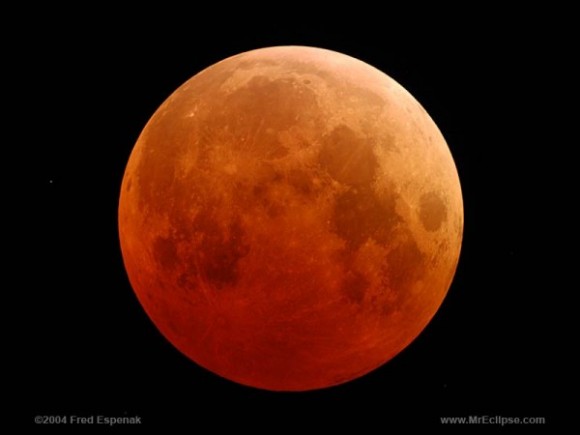
The full moon nearly always appears coppery red during a total lunar
eclipse. That’s because the dispersed light from all the Earth’s
sunrises and sunsets falls on the face of the moon at mid-eclipse. Thus
the term
blood moon can be and probably is applied to any and
all total lunar eclipses. It’s only in years where volcanic activity is
pronounced that the moon’s face during a total lunar eclipse might
appear more brownish or gray in color. Usually, the moon looks red. We
astronomy writers often say it looks
blood red. Why? Because it sounds dramatic, and a lunar eclipse is a dramatic natural event.
Read more here: Why does the moon look red during a total lunar eclipse?
What’s more, in folklore,
all the full moons have names. The names typically coincide with months of the year, or seasons. One of the most famous moon names is
the Hunter’s Moon. It is the the
full moon immediately following
the Harvest Moon, which is the full moon occurring most closely to the autumnal equinox.
The Hunter’s Moon, in skylore, is also sometimes called the Blood
Moon. Why? Probably because it’s a characteristic of these autumn full
moons that they appear nearly full – and rise soon after sunset – for
several evenings in a row. Many people see them when they are low in the
sky, shortly after they’ve risen, at which time there’s more atmosphere
between you and the moon than when the moon is overhead. When you see
the moon low in the sky, the extra air between you and the moon makes
the moon look reddish. Voila. Blood moon.
The second total lunar eclipse of the coming lunar tetrad will take
place on October 8, the same night as the Hunter’s Moon. So there will
be two reasons to use the term Blood Moon that night.
Dates for the Northern Hemisphere’s Harvest and Hunter’s Moons in 2014 and 2015:
2014:
Harvest Moon: September 9
Autumn Equinox: September 23
Hunter’s (Blood) Moon: October 8
2015:
Autumn Equinox: September 23
Harvest Moon: September 28
Hunter’s (Blood) Moon: October 27
Bottom line: The term Blood Moon in Biblical prophecy appears to have
been popularized by two Christian pastors, Mark Blitz and John Hagee.
They use the term
Blood Moon to apply to the full moons of the upcoming
tetrad
– four successive total lunar eclipses, with no partial lunar eclipses
in between, each of which is separated from the other by six lunar
months (six full moons) – beginning on the night of April 14-15, 2014.
.